

What Is A Typical Typo
A typographical mistake (often shortened to typo), also chosen a misprint, is a error (such as a spelling mistake)[1] made in the typing of printed (or electronic) material. Historically, this referred to mistakes in manual type-setting (typography). Technically, the term includes errors due to mechanical failure or slips of the paw or finger,[2] but excludes errors of ignorance, such every bit spelling errors, or irresolute and misuse of words such as "than" and "then". Before the arrival of press, the "copyist'south error" or "scribal fault" was the equivalent for manuscripts. Nigh typos involve uncomplicated duplication, omission, transposition, or commutation of a small number of characters.
"Fat Finger", or "Fatty-Finger Syndrome" (too used in financial sectors), a slang term, refers to an unwanted secondary action when typing. When one's finger is bigger than the impact zone, there tin be inaccuracy in the fine motor movements and accidents may occur. This is mutual with touchscreens. One may hit two adjacent keys on the keyboard in a single keystroke. An example is "buckled" instead of "bucked", due to the "L" key'south beingness next to the "Grand" fundamental on the QWERTY keyboard, the most common keyboard for Latin-script alphabets.
Marking typos [edit]

Correction fluid is used to correct typographical errors after the document is printed.
When using a typewriter without correction record, typos were normally overstruck with another character such as a slash. This saved the typist the problem of retyping the entire page to eliminate the error, only as evidence of the typo remained, it was not aesthetically pleasing.
In estimator forums, sometimes ^H (a visual representation of the ASCII backspace character) was used to "erase" intentional typos: Be prissy to this fool^H^H^H^Hgentleman, he'due south visiting from corporate HQ. [3]
In instant messaging, users oftentimes send messages in haste and only later on discover the typo. It is common practice to right the typo by sending a subsequent message in which an asterisk is placed before (or after) the right word.[four]
In formal prose, information technology is sometimes necessary to quote text containing typos or other doubtful words. In such cases, the author will write "[sic]" to indicate that an error was in the original quoted source rather than in the transcription.[5]
Scribal errors [edit]
Scribal errors received a lot of attention in the context of textual criticism. Many of these mistakes aren't specific to manuscripts and can be referred to as typos. Some classifications include homeoteleuton and homeoarchy (skipping a line due to the similarity of the ending or beginning), haplography (copying once what appeared twice), dittography (copying twice what appeared once), contagion (introduction of extraneous elements), metathesis (reversing the lodge of some elements), unwitting mistranscription of similar elements, mistaking similar looking letters, substitution of homophones, fission and fusion (joining or separating words).[6] [seven]
Biblical errors [edit]
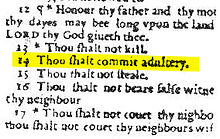

The Wicked Bible omits the give-and-take "not" in the commandment "yard shalt non commit adultery".
The Judas Bible is a copy of the second folio edition of the authorized version, printed by Robert Barker, printer to Male monarch James I, in 1613, and given to the church building for the use of the Mayor of Totnes. This edition is known as the Judas Bible because in Matthew 26:36 "Judas" appears instead of "Jesus". In this re-create, the fault (in the carmine circle) is corrected with a slip of paper pasted over the misprint.
"Intentional" typos [edit]
Certain typos, or kinds of typos, have acquired widespread notoriety and are occasionally used deliberately for humorous purposes. For instance, the British newspaper The Guardian is sometimes referred to as The Grauniad due to its reputation for frequent typesetting errors in the era before computer typesetting.[8] This usage began as a running joke in the satirical magazine Private Eye.[ix] The magazine continues to refer to The Guardian by this proper name to this day.
Typos are common on the internet in chatrooms, Usenet, and the World Broad Spider web, and some—such as "teh", "pwned", and "zomg"—accept become in-jokes among Internet groups and subcultures. P0rn is not a typo just an case of obfuscation, where people make a word harder for robots to understand past changing information technology.[10]
Typosquatting [edit]
Typosquatting is a course of cybersquatting which relies on typographical errors made past users of the Internet.[11] Typically, the cybersquatter volition annals a likely typo of a frequently-accessed website accost in the hope of receiving traffic when internet users mistype that accost into a web browser. Deliberately introducing typos into a web page, or into its metadata, tin too draw unwitting visitors when they enter these typos in Cyberspace search engines.
An case of this is gogole.com instead of google.com which could potentially exist harmful for the user.
Typos in online auctions [edit]
Since the emergence and popularization of online sale sites such as eBay, misspelled auction searches take chop-chop become lucrative for people searching for deals.[12] The concept on which these searches are based is that, if an individual posts an sale and misspells its description and/or title, regular searches volition non find this auction. However, a search which includes misspelled alterations of the original search term in such a way as to create misspellings, transpositions, omissions, double strikes, and wrong fundamental errors would observe most misspelled auctions. The resulting outcome is that there are far fewer bids than there would exist under normal circumstances, assuasive the searcher to obtain the detail for less. A serial of tertiary-party websites take sprung up allowing people to find these items.[thirteen]
Atomic typos [edit]
Another kind of typo—informally called an "atomic typo"—is a typo that happens to result in a correctly spelled word that is different from the intended one. Since it is spelled correctly, a simple spellchecker cannot find the mistake. The term was used at least as early on as 1995 by Robert Terry.[14]
A few illustrative examples include:
- "now" instead of "not",[15] [16]
- "unclear" instead of "nuclear"
- "you lot" instead of "your"
- "Sudan" instead of "sedan" (leading to a diplomatic incident in 2005 between Sudan and the United States regarding a nuclear exam code-named Sedan)
- "Untied States" instead of "United States"
- "the" instead of "they"
and many more. For any of these, the converse is too true.
Run across likewise [edit]
- Clerical error – Mistake in clerical piece of work, e.thousand. data entry
- Comparison of spider web browsers – Native spell checkers are indicated in the table "Browser features".
- Fatty-finger fault – Keyboard input error in financial markets
- Human error – Action with unintended consequences
- Orthography – Conventions when writing in a language
- Scrivener's error – Clerical error in a legal document
- Titivillus - devil said to collect or cause errors.
- Transcription fault – Data entry error
References [edit]
- ^ "Typo - Definition". Free Merriam-Webster Dictionary. Merriam-Webster. Retrieved 2012-01-03 .
- ^ "Wordnet definition". Wordnet. Princeton University. Retrieved 2007-xi-12 .
- ^ Chapter v. Hacker Writing Style, The Jargon File, version iv.4.7
- ^ Magnan, Emerge Sieloff (2008). Mediating discourse online. AILA Applied Linguistics Series. John Benjamins Publishing Company. p. 260. ISBN978-90-272-0519-3.
- ^ Wilson, Kenneth G. (1993). "sic (adv.)". The Columbia Guide to Standard American English. Columbia University Press. Archived from the original on eleven December 2007. Retrieved 2007-eleven-12 .
- ^ Paul D. Wegner, A pupil's guide to textual criticism of the Bible: its history, methods, and results, InterVarsity Printing, 2006, p. 48.
- ^ "Manuscript Studies: Textual analysis (Scribal error)". www.ualberta.ca. Archived from the original on 4 April 2016. Retrieved 2 May 2018.
- ^ Taylor, Ros (2000-09-12). "Net know-how: Spelling". Guardian Unlimited . Retrieved 2007-11-12 .
- ^ Lyall, Sarah (1998-02-16). "Confession as Force At a British Newspaper". The New York Times . Retrieved 2007-11-12 .
- ^ Marsden, Rhodri (2006-10-18). "What do these foreign web words mean?". The Independent . Retrieved 22 December 2016.
- ^ Sullivan, Bob (2000-09-23). "'Typosquatters' turn flubs into greenbacks". ZDNet. Archived from the original on 2007-ten-24. Retrieved 2007-11-12 .
- ^ KING5 Staff (2004-07-01). "How finding mistakes can net great deals on eBay". King5. KING-TV. Archived from the original on 2007-12-xx. Retrieved 2007-11-12 .
- ^ Douglas Quenqua (2008-11-23). "Help for eBay Shoppers Who Can't Spell". The New York Times.
- ^ Hanif, C. B. (Baronial 10, 1995). "Hurricane Coverage Kicks Up Dust". The Palm Beach Post. p. 14. Retrieved January 25, 2018 – via Newspapers.com.

- ^ Callan, Tim (2011-04-23). "The now vs. not typo". Tim Callan on Marketing and Technology . Retrieved 2021-08-13 .
- ^ Karr, Phyllis Ann (2012). Frostflower and Thorn. Wildside Press. p. 415. ISBN9781479490028.
External links [edit]
- BookErrata.com
- How Many Errorrs are in this Essay? on famous typos, in The Millions

What Is A Typical Typo,
Source: https://en.wikipedia.org/wiki/Typographical_error
Posted by: rosassheaverve02.blogspot.com
0 Response to "What Is A Typical Typo"
Post a Comment