

How To Fix The Latest Android Bug
We want to fix your bugs! But many bugs don't include required information. So we are focusing our express resource on bugs that take complete reports. To amend the chances of your bug existence fixed, please take a moment to read this document.
If y'all don't follow these steps, we will close your bug. If that happens, just resubmit with the additional information.
Also note that the issue tracker is non a support forum. If y'all have questions virtually how to use the tools, or how to get your Android app to work, delight visit stackoverflow.com or ane of the several Android developer support resource.
How to report a bug
-
Make certain you are using the latest versions of the tools. This saves the states from reviewing bugs that take already been fixed. If possible, also search for similar problems on the consequence tracker for Android Studio to run into whether the issue y'all're seeing has already been reported (yous can ordinarily use the mistake message as a search keyword).
-
Open up a bug written report from Android Studio by selecting Aid > Submit Feedback. This is the easiest way to start a bug considering it populates the bug report with your Android Studio version, Java version, and system information, which we need to properly reproduce the upshot. (Otherwise, file your problems here and add the version information by hand.)
-
Describe the exact steps to reproduce. If we tin can reproduce the upshot on the first effort, the odds of a ready are much better. If possible, include a code snippet (or better yet, point to a github project which tin can be used to reproduce the bug). Screenshots are also helpful to show what you are observing.
-
Depict what you expected to happen, and what you lot instead observed.
-
Pick a descriptive summary for the bug. You'd be surprised how many bugs are filed with the summary "Problems," "Outcome," "Exception," "Not working," and so on, which makes it hard for us to sort the issues.
-
For certain kinds of bugs, we need additional information:
- Details for Android Studio bugs
- Details for build tools and Gradle bugs
- Details for Android Emulator bugs
Details for Android Studio bugs
Include the post-obit additional information that is specific for Android Studio bugs.
If the IDE hangs
If the IDE itself appears to be very sluggish or completely frozen, generate a couple of thread dumps and attach them to the bug report. These tell us what the IDE is so busy doing (or what contended resource information technology'southward waiting for).
If the IDE is sluggish but not frozen, too attach the idea.log file (select Help > Show Log in Files, or Show Log in Finder on a Mac). This shows united states whether the reason the IDE is sluggish is that it's constantly throwing errors into the log.
Using CPU profiles to diagnose slowness
If you are experiencing languor in Android Studio, CPU profiles can sometimes help diagnose the upshot. Use these steps to capture a CPU profile captured using the Android Studio/IntelliJ Performance Testing plugin:
-
Install the plugin. This can exist done directly from Android Studio past searching for "Operation Testing" in the plugin marketplace. Alternatively, you can download a Studio-compatible version from the plugin website.
-
Create the CPU profile. When Android Studio seems to be sluggish, choose "Beginning CPU Usage Profiling", repeat a few actions for which latency is problematic (code completion, typing and waiting for highlighting to catch up, etc.) so hit "Stop CPU Usage Profiling."
-
Share the profile file. A balloon will appear providing the CPU snapshot file name, which should follow the format
snapshot-NNN. Please share that snapshot file in your bug report.
If the IDE runs out of memory
Retentiveness problems in Android Studio are sometimes difficult to reproduce and written report. To aid solve this problem, Android Studio includes a memory usage study that you can ship to the Android Studio squad to assistance identify the source of the memory issues.
Run a memory usage report
To run a memory usage written report, follow these steps:
-
Click Assist > Clarify Memory Usage from the carte bar.
Android Studio dumps the heap and prompts you lot to restart the IDE. If you restart the IDE, the heap dump analysis starts immediately. Otherwise, the heap dump analysis starts the next time you run Android Studio. In either instance, the IDE notifies y'all one time the memory usage report is ready for you to review.

-
Click Review Report.
Before you send the report, you can review all of the information that'south included.
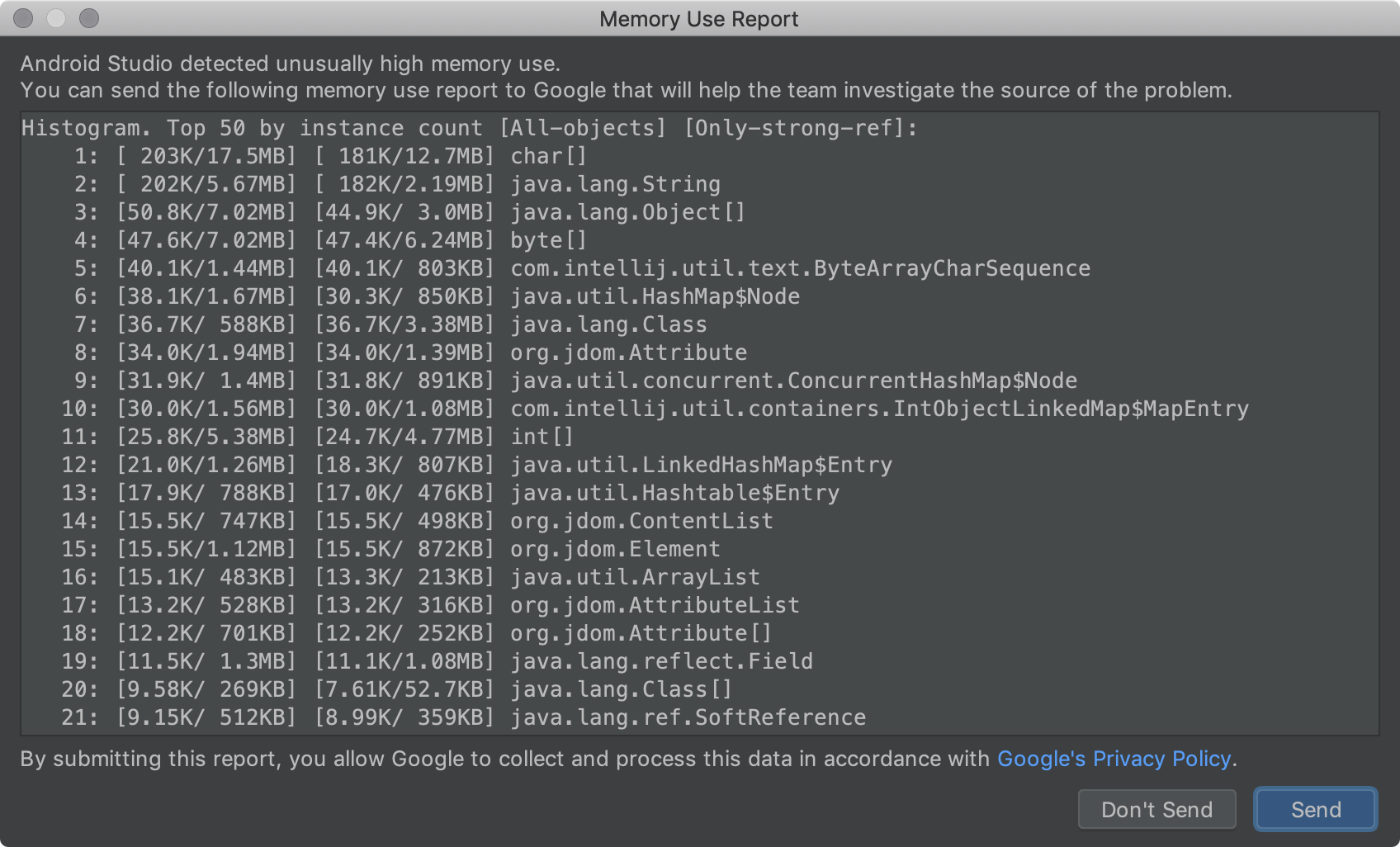
-
After yous've finished your review, copy and paste the contents of the written report into a file and adhere that file when you file your bug.
Submitting the written report information this way ensures that the Android Studio team can communicate with you using the issue tracker while we are investigating your memory issues.
If the IDE crashes or throws exceptions
For other types of crashes, attach the idea.log file. Select Help > Show Log in Files, or Show Log in Finder on a Mac).
Generating a thread dump
A thread dump is a printout of all the threads running in the JVM, and for each thread, a printout of all the stackframes. This makes information technology like shooting fish in a barrel to run across what the IDE is busy doing, especially if you generate a couple of thread dumps a few seconds autonomously.
When yous report bugs where the IDE is extremely busy with a pegged CPU, or where the IDE appears to have frozen, a thread dump tin pinpoint either what lawmaking is doing a lot of work, or which threads are contending over resource and causing a deadlock.
The JDK ships with a tool named "jstack" which can be used to generate a thread dump. First you lot'll need to find the process id of the Android Studio process. You lot can use the "jps" command for that. (Both jstack and jps are in the bin directory of the JDK. If you take multiple JDKs installed, you should use the same version here as the 1 you are running Android Studio with, and you lot can see what version that is in Android Studio'south Nearly box.)
On Linux, Mac:
jps -mv | grep studio For Windows:
jps -mv | findstr studio For case, this will print out a long line like this:
$ jps -mv | grep studio 37605 -Dfile.encoding=UTF-8 -ea -Dsun.io.useCanonCaches=false -Djava.internet.preferIPv4Stack=true -Djna.nosys=true ... The start number on the left, 37605 in this case, is the process ID.
Next, you tin generate a thread dump and salvage it to the file dump.txt like and so:
jstack -fifty pid >> dump.txt If that does not work, there are some additional platform-specific ways yous tin generate a thread dump; see IntelliJ Back up for detailed instructions.
Details for build tools and Gradle bugs
Adhere a real or sample projection that demonstrates the effect. This is the best way to ensure all of the data needed is captured. Exist sure to remove any sensitive information before sharing.
If you cannot share a project, please betoken the versions of the tools you're using (effort to use the latest stable or preview versions beginning):
- Android Gradle plugin version: Select File > Project Construction, click Project, and and so locate Android Gradle Plugin Version.
- Gradle version: From the above page, locate Gradle Version.
- Android Studio version: Select Help > About and locate the Android Studio version.
Additionally, include the following information where applicable:
- If a behavior has inverse unexpectedly from an earlier version to the current version, indicate both versions.
- If the build failed with an fault, run the build from the command line with the
--stacktraceoption (i.e.,./gradlew <task> --stacktrace) and provide us with a stack trace. - If the build takes longer than expected, try one of the post-obit:
- Run
./gradlew <task> --scanand share with usa the generated Gradle build scan. - Run
./gradlew <chore> -Pandroid.enableProfileJson=trueand share the Chrome-trace files generated under the<root-project>/build/android-profiledirectory.
- Run
Details for Android Emulator bugs
The easiest way to assemble the emulator details is to utilise the File a bug feature in the extended controls:
- Click More than
 in the emulator panel.
 -
In the Extended controls window, select Bug Written report on the left.
This opens a screen where you can run across the issues report details such every bit the screenshot, the AVD configuration info, and a bug report log. Y'all tin can enter the steps to reproduce here or wait and type them into the written report generated in the next step.
-
Await for the bug report to terminate collecting, and and so click Send to Google. This opens a window for y'all to salvage the bug report in a folder and and so opens your browser to create a report in the Google Issue Tracker, with the necessary emulator details filled in.
-
In the written report, complete whatever remaining details such as the steps to reproduce the bug and attach the files saved when you created the bug report.
Otherwise, y'all must manually enter the post-obit details:
- Emulator Version. In the emulator, open the Extended controls, click Help, and so click the About tab to observe the Emulator version
- Android SDK Tools version. Select Tools > SDK Managing director, click SDK Tools, and then locate Android SDK Tools
- Host CPU Model.
- On Linux: Open
/proc/cpuinfo - On Windows: Right-click My Computer and select Backdrop
- On Mac: Click the Apple icon and click Most This Mac
- On Linux: Open
- Device name. From the AVD Manager, click to open up the drop-down carte du jour in the Actions column for the device, and then select View Details (or open up the
$avdname.avd/config.inifile). Observe the entry for hw.device.name. For example:hw.device.name=Nexus 5

How To Fix The Latest Android Bug,
Source: https://developer.android.com/studio/report-bugs
Posted by: rosassheaverve02.blogspot.com
0 Response to "How To Fix The Latest Android Bug"
Post a Comment